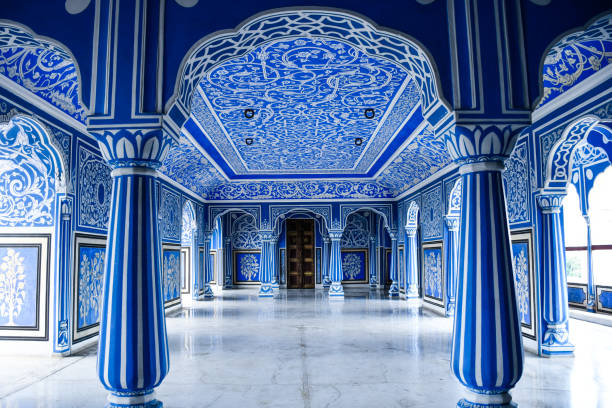
About City Palace
The City Palace, Jaipur was established in 1727 by Maharaja Sawai Jai Singh II, who moved the capital from Amber to Jaipur. The palace complex is a stunning blend of Rajasthani and Mughal architecture, encompassing a vast array of courtyards, gardens, and buildings.
History
The palace was built between 1729 and 1732, initially by Sawai Jai Singh II. Later rulers added to the palace complex, making it an impressive mix of Rajasthani and Mughal architectural styles. The complex served as both the seat of the Maharaja and the center of arts and learning.
The palace complex includes several major structures: Chandra Mahal, Mubarak Mahal, Diwan-i-Khas (Hall of Private Audience), Diwan-i-Aam (Hall of Public Audience), and the gateway Ridhi Sidhi Pol with its four small gates decorated with themes representing the four seasons.
Today, while part of the palace complex is open to the public as the City Palace Museum, a significant portion still serves as the residence of Jaipur's royal family. The museum houses a remarkable collection of royal costumes, delicate miniature paintings, and impressive armaments.